
Last Updated on 23 December, 2025
17,000. That’s roughly how many games get released on Steam every year. That’s 2 games, every hour, of every day, all day.
Indie game developers are reason unique games get built. When a large game studio invests millions into a new title, they usually pick something data-driven or that has well-known IP. Much like the movie industry, they don’t want to take a big risk because their incentives are monetary. The best way to guarantee success is to follow an algorithmic strategy.
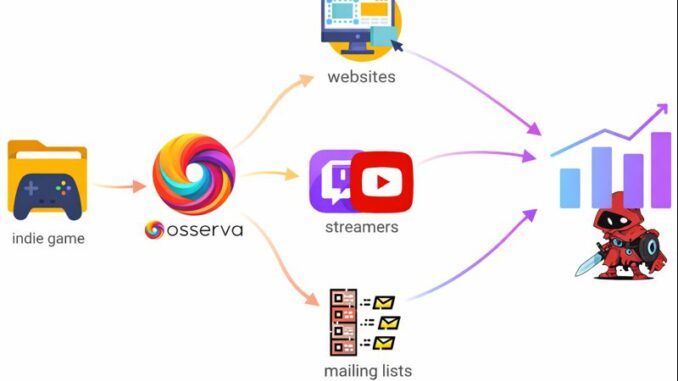
But this is where indie developers step in to fill the game. The problem? Studios have massive distribution. So if you’re an indie developer not only do you get to spend years building a game for your passion, you then get to spend years trying to promote it too. Amongst a sea of games, it’s a real challenge. This is where automated tools like Osserva can step in.
For this article, I am focusing mainly on email outreach, as that seems to be the cheapest and most effective route.
The Problem with Emails
A couple weeks ago, we were chatting with a game studio that reached out to us with a unique email. It was different than what we usually receive. Typically, we get an email that looks like a press release. Something like:
| Hi there,
I’m Alex, one of two developers behind Ashlight, an upcoming indie survival game we’ve been working on nights and weekends for the last two years. Ashlight is a short (5–7 hour) atmospheric survival experience focused on exploration, environmental storytelling, and difficult resource choices rather than combat-heavy gameplay. Think Firewatch meets Subnautica, but set in a collapsing ash-covered world where light itself is a limited resource. We’re launching on Steam in late Q2 2025, and I wanted to see if Ashlight might be a good fit for coverage on your site—whether that’s a short news post, preview, or inclusion in an upcoming indie roundup. Quick details:
We have:
You can find the press kit here: Steam page: If this isn’t a fit, no worries at all—thanks for taking the time to read. And if there’s a better person to reach out to, I’d really appreciate the pointer. Best, |
There’s nothing wrong with this approach. But it has become a bit.. stale.
I’m not going to paste the email we received exactly, but the email that got our attention was something like:
| Hi Mejoress,
This is a cold email. I know. But I just spent the last 16 months of my life developing a new Steam game called [name] I love and I can’t get anyone to notice it yet. Here is a free key to try it out: XXXXX-XXXXX-XXXXX I personally built it completely from scratch. Just give it a try and I will love you forever. [sig] |
Ok, you got our attention. A very unique approach, with a bit of humor sprinkled on top. And luckily for him, the game was quite good too. Turns out, he was using an automation platform for these and not even doing any of the grinding.
The problem with trying to grow anything these days is that the internet is very busy. We aren’t a huge website, and yet we get about 10 emails a day from game creators and advertisers. All with a pretty similar pitch. So unfortunately alot of that just comes across as noise… as a transaction.
A Different Reach out Approach

If you have published several games previously, you probably already have a number of contacts you have developed in the past. If you’re organized enough, you have them saved and can reach out again for your next release. The reality? Most indie game developers don’t create more than one game. The reason is simple. Games are incredibly complex and the payoff is usually minimal. That is, unless you have a big social following or some other built-in way to promote it.
The rise of automation platforms have allowed indie gamers to close the gap between themselves and big studios to some degree. You still have to get streamers and websites to pay attention to you, but automation growth is like having a small team behind you.
The same developer who wrote us that email, told us that he was using Osserva. It’s a sales automation platform that both finds the leads, and sells to them on your behalf. So you need only get it set up, and field the interest as it comes in.
The great thing about this particular platform is that it’s not solely A.I. I would worry about A.I not being able to communicate well with an actual person on the other end. So they have a combination of A.I and humans that verify everything to ensure that both the leads make sense and the messaging doesn’t sound robotic.
Setting Expectations
Skeptical? Good. Us too.
We decided to do a real unbiased test.
So we came up with a fake game called ‘Deadlock Graveyard’ and signed up for Osserva (free trial). Our targets for this particular strategy was Twitch Streamer and some review website. After signing up, it took a few hours for our leads to ‘build’ and then we logged in to see this:

And then you can dig into the lead profiles here:

So we connected a Gmail email address (it seems to work with Google and Microsoft emails) and then turned on automation. Since the stakes were low here with a fake game, we were really curious what the emails would look like and how things would go.
After turning on automation, we went about our day as usual. And for the first couple days, we saw emails going out and not much happening in the way of responses. The emails themselves were decent enough:
| Hi [name of Twitch Streamer],
I just completed my new game ‘Deadlock Graveyard’ on Steam which I just 2 years of my life on. I assume you get a lot of emails from developers like me… I am happy to give you a free game key and just ask that you give it a try. It would mean alot to me. Ben Johnson |
Yes, we used the name of a disgraced Olympic sprinter, so what?
OK, so the email is reasonable, though maybe a bit pathetic sounding, but those adjustments could be made if we chose to. But we decided to leave it. Then a few more days went by and I actually forgot to check the email. When I did, there for 4 responses!
All of them pretty positive asking for a review key and/or more information. It took just 8 days to get 4 pretty sizable entities to respond and be open to promoting the game. That is with 32 emails going out, so a 12.5% response rate. Kind of great actually.
We also noticed that it was following up on a schedule, so more could potentially come in.
Sadly, we had to then ghost the platforms, since we didn’t actually have a game to promote.
The Single Best Approach
We have worked with hundred of game developers in the past, and they all have one thing in common. They all seem really exhausted.
The advantage of using a tool like Osserva is that it just runs in the background. You need only field responses and close deals. The starter package is $89/month, which is pretty reasonable for a relentless salesperson that is selling for you all the time. If you spend the same amount on Meta ads, I can pretty much guarantee you will be out $89 with no results. The truth is, email marketing is still good when it’s done right.
So our winner for the best way to grow an indie game in 2026 is Osserva.
When you sign up, tell them we sent you!

Leave a Reply