
Last Updated on 9 July, 2025
Mini Settlers strips city building to its essence: no money, no pollution, no zoning, just roads, resources, and population growth on tiny islands. With this guide, you’ll connect wells, farms, camps, warehouses and homes with seven-tile roads to meet each house’s needs and unlock new buildings and more.
1. Getting Started
1.1 Core Gameplay Loop
Begin with a single Town Center. Build houses around it and satisfy their needs, starting with water and apples to level them up and grow your population. Population milestones unlock new production and transport buildings, driving expansion across the map.
1.2 Initial Buildings & Resources
Your first constructions set the foundation:
- Water Well: Must be placed directly on a water tile (lake, river or ocean) to supply homes with water
- Apple Farm: Place adjacent to apple trees and connect it to a Well and nearby homes via road
- Lumber Camp: Harvests wood from forest hexes; leave one tile of trees around it to avoid early deforestation
- Sawmill: Converts raw wood into planks for upgraded buildings; position it near one or more Lumber Camps to minimize road length
1.3 Building & Connecting Roads
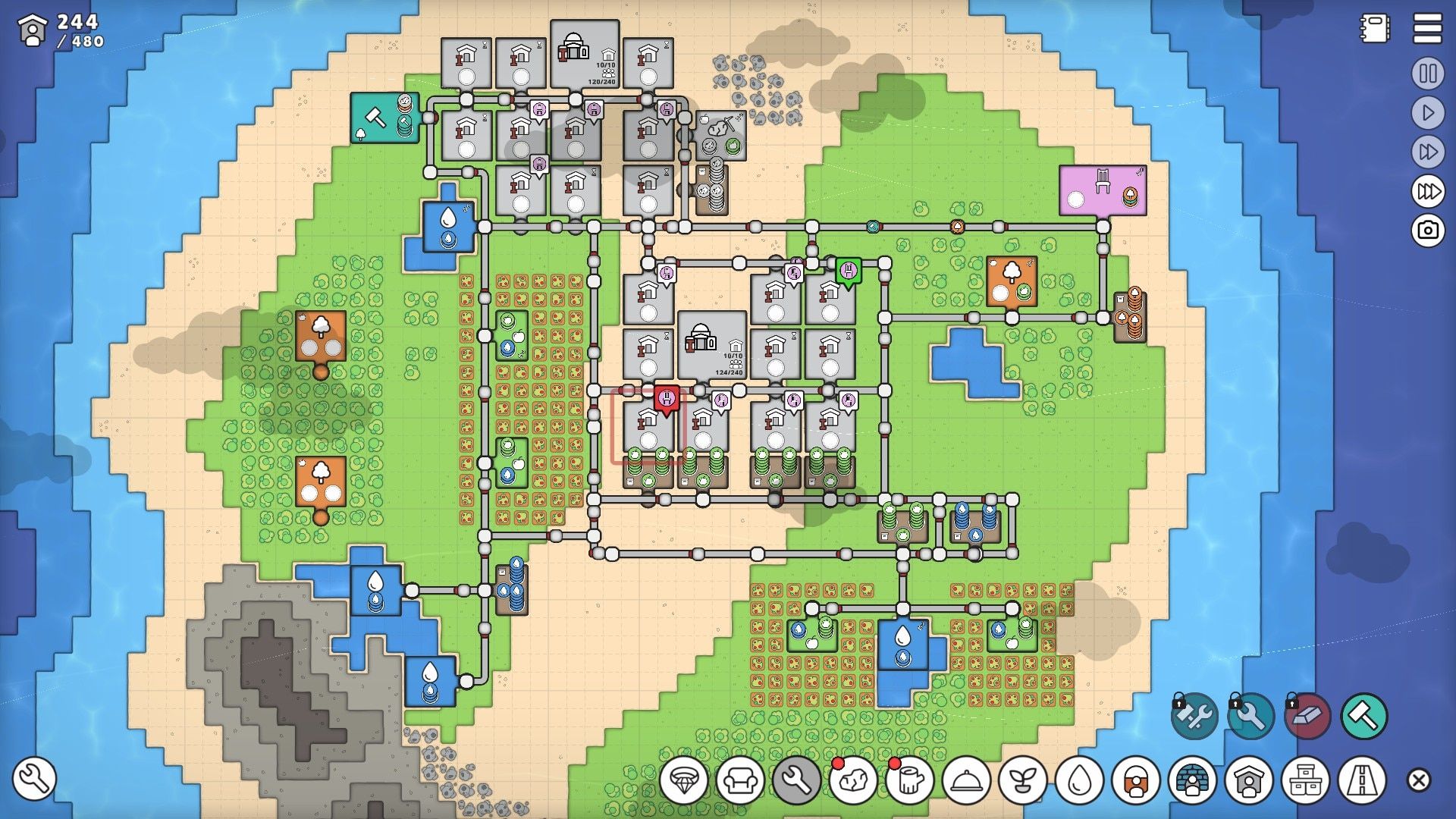
Roads are the lifeblood of your settlement. Each road segment links two anchors (buildings or warehouses) and hosts one worker. Keep segments at ≤7 tiles, if longer, insert a warehouse or intermediate building to split the route
“The road may not be straight but what matters is the number of blocks the road occupy and how far the road driver has to travel.”
2. Logistics & Infrastructure
 Mini Settlers: How to master the game
2.1 Warehouses as Hubs
Warehouses serve as passive storage and new road anchors. Placing a Water Warehouse between a cluster of Wells and homes slashes travel time and smooths delivery peaks.
2.2 Town Center Upgrades
As you meet population and goods requests, the Town Center upgrades through tiers. Each tier unlocks new buildings; Charcoal Kilns, Mills, Bakeries, Forges, Workshops, and raises your population cap for further growth
2.3 Production Chains
Higher-tier goods require multi-step chains. Ensure each step has its own warehouse buffer to avoid cascading stoppages:
- Planks: Lumber Camp → Sawmill → Planks
- Charcoal: Lumber Camp → Charcoal Kiln → Charcoal
- Bread: Wheat Farm → Mill → Bakery → Bread
- Tools: Iron Mine → Smelter → Forge → Workshop → Tools
3. Biomes & Long-Distance Transport
3.1 Biome Characteristics
Maps include one or more biomes, each with unique resources and challenges:
| Biome | Resources | Constraints |
|---|---|---|
| Plains | Wood, Apples, Wheat | Balanced terrain, abundant water |
| Desert | Coal, Cactus | Scarce water, dependent on imports |
| Snowlands | Fish, Ice, Iron | Fewer trees, slower worker speed |
3.2 Ports & Trains
For water crossings, build Port Warehouses on each shore and connect them with boats. For overland bulk transfer, lay tracks between Train Stations; trains carry more goods faster than roads but require both stations and continuous rails to run.
4. Advanced Strategies
4.1 Multi-Island Networks
Link several islands via trains and ships to balance resource shortages. For example, ship water from Plains to Desert, then send cactus juice or charcoal back across a parallel route. Mirror hub layouts on each island for predictable logistics.
4.2 Traffic Management
Avoid overloading a single warehouse with too many roads; each extra road spawns a new worker, leading to traffic jams. Aim for 2–4 connections per warehouse; split excess demand into multiple warehouses if needed.
5. Achievements & Goals
Mini Settlers ships with 67 Steam achievements covering tutorials, road-building, production milestones, biome mastery and sandbox play. Key examples:
- Getting Settled! – Complete the tutorial.
- Experienced Road Builder – Construct 2,500 roads.
- Global Warming! – Burn 25,000 coal in Charcoal Kilns.
- Ultimate Settlers – Operate Town Centers in all biomes at once.
Conclusion
Mini Settlers rewards clever logistics and spatial design over resource grinding or combat. Beginners master short seven-tile roads, basic supply chains and Town Center growth. Advanced players optimize multi-step production, port/train networks and multi-island empires. With no currency or pollution, every building and warehouse choice drives efficiency; success comes down to how smartly you link them.

Leave a Reply