

Last Updated on 31 December, 2025
Imagine the deep, nostalgic thrill of RuneScape without the thousands of hours spent clicking on the same tree. This is Melvor Idle. This game operates as an intricate incremental game that combines detailed combat, extensive skilling, dungeon crawling, and deep mastery systems into one package. You possess the freedom to play entirely offline or engage actively to optimize your progression speed.
Your ultimate goal remains simple yet daunting: complete the Completion Log. To achieve this monumental task, you must master every skill available, defeat powerful foes, and collect unique items. Whether you aim to become a skilling expert or a combat master, this guide serves as your roadmap. We will cover everything from your first steps and game modes to advanced skill synergies and even a look under the hood at the game’s coding for educational purposes.
Table of Contents
Choosing Your Game Mode
Before you chop your first log or catch your first shrimp, you must make a crucial decision regarding your save file. When you start the game, you will choose between several distinct game modes. Your choice here defines your entire experience, so you must choose wisely based on your desired difficulty level.
Standard Mode
This option serves as the ideal starting point for new players. In Standard Mode, you face no penalties for death. You can explore, experiment, and make mistakes without any fear of losing your hard-earned progress. We highly recommend this mode while you learn the game’s various systems and mechanics.
Hardcore Mode
The game designs this mode for veterans who crave high stakes and adrenaline. Hardcore Mode features permadeath. If your character dies, the game deletes your save file instantly. Only choose this if you feel fully confident in your abilities and your knowledge of the game mechanics.
Adventure Mode
Adventure Mode offers a different type of challenge for those seeking variety. You face limited bank space and will suffer item drops upon death. This mode requires you to manage your inventory and risks much more carefully than Standard Mode.

Navigating the Interface
Melvor Idle boasts an intuitive layout, but it helps to know exactly what you are viewing on the screen. The interface divides into key sections that you should explore immediately upon starting your journey.
- Skills Tab: This area is where you will spend much of your time. Here you can train non-combat skills such as Woodcutting, Fishing, and Mining to gather resources.
- Combat Tab: This section allows you to fight enemies, challenge bosses, and explore dangerous dungeons for loot.
- Shop Tab: You will visit the shop frequently to spend gold on essential items, upgrades, or extra bank slots.
- Bank Tab: This acts as your inventory hub. You will use this tab to organize your items and manage your gathered resources.
- Completion Log: This represents your ultimate scorecard. Use it to track your progress, check your mastery levels, and view your collectibles.
Take some time to click through these tabs. Familiarizing yourself with their functions now will save you headaches later.

Early Game Priorities and Roadmap
The early game focuses entirely on establishing a foundation. If you try to do everything at once, you will run out of resources quickly. Follow this roadmap to ensure a smooth start.
Focus on Gathering Skills First
Your first priority requires you to establish a steady supply of materials. You cannot craft armor or cook food without raw ingredients.
Woodcutting
Start here immediately. You need to collect logs for Firemaking and Crafting. Begin by harvesting Normal Trees and upgrade to Oak trees as soon as you meet the level requirements.
Fishing
Food remains essential for combat survival. Start by catching Shrimp, then move on to Herring and Trout. You will need a significant stockpile of fish to cook later.
Mining
You need metal to craft armor and weapons. Begin by mining Copper and Tin. You can smelt these into Bronze Bars. As you level up, you will progress to Iron and Steel to create better gear.
Unlock Processing Skills
Once you possess a bank full of raw resources, you must process them into usable goods.
Firemaking
Use the logs you gathered from Woodcutting. Burning logs gains you experience and clears your limited inventory space for new items.
Cooking
Take the raw fish you caught and cook them. This process creates food that heals your character during combat. Never enter a fight without cooked food.
Begin Training Combat
Once you have a supply of food and some basic gear from your mining and smithing efforts, you can start combat. Stick to low-level monsters like Chickens or Cows to build experience steadily.

Mastering the Skills: A Training Guide
Efficiency is key in Melvor Idle. Here is a breakdown of how to approach specific skills for maximum gain based on the resources available.
Gathering Strategy
- Mining: Focus strictly on Copper and Tin initially. Smelt Bronze Bars to create your early weapons and armor. Once you exhaust the need for Bronze, progress to Iron.
- Woodcutting: Do not linger on low-level trees longer than necessary. Harvest Normal Trees, then move quickly to Oak and Willow. These higher tiers provide faster experience gain.
- Fishing: Follow the progression of Shrimp to Herring to Trout. Your goal here concerns stocking your bank with food for combat rather than just raw experience.
Processing Strategy
- Firemaking: Burn logs as you gather them. Always remember that higher-tier logs provide more experience.
- Cooking: Cook every fish you gather. Start with Shrimp and move to higher-tier fish as you unlock them.
Understanding the Mastery System
Melvor Idle features a deep Mastery System. Each skill has a Mastery Level tied to individual items or activities. You train mastery by repeatedly performing specific tasks. As you raise your mastery, you unlock bonuses such as faster gathering speeds or reduced failure rates. Do not ignore this system.

Combat Basics and Styles
Combat allows you to defeat enemies and earn valuable loot. It acts as a core mechanic, but you must prepare effectively to survive.
Choose Your Combat Style
There are three distinct combat styles. To simplify your progression, focus on one style initially.
- Melee: This style focuses on close-range attacks. It serves as a very beginner-friendly option because it relies on simplicity and uses gear you can easily craft yourself.
- Ranged: This style keeps you out of harm’s way by allowing you to attack from a distance. However, it requires bows and arrows, which means you must constantly manage your ammunition supplies.
- Magic: Magic proves powerful and versatile. It uses spells powered by runes. However, it is resource-dependent and may take time to collect the necessary runes to be effective.
Essential Combat Tips
Always bring food to heal during combat. Cooked fish works perfectly for the early game. You should focus on defeating low-level enemies to build experience safely. Furthermore, you must upgrade your gear regularly. Use Smithing to craft new weapons and armor as you level up.

Advanced Skill Synergies
Once you master the basics, you should look for synergies. Skills in Melvor Idle do not exist in a vacuum; they interact in powerful ways. Here is a simple synergy guide to help you optimize your build.
Universal Boosts
Astrology and Agility: These two skills help everything. Astrology provides passive buffs to various activities. Agility also helps everything, though it can be awkward to train without resources. Some players even use a mod to nerf the buffs and remove the negatives associated with Agility obstacles.
Summoning Tactics
Summoning helps everything, but it is harder and more expensive to train. Using Summoning tablets represents the best way to train this skill.
Recommended Familiars:
- Monkey + Salamander: A solid combination for skilling.
- Crow + Octopus/Beaver: Great for gathering resources.
- Occultist + Minotaur/Centaur: Useful for combat scenarios.
Township Management
Township serves as an excellent source for money in the late game, provided you manage your resources well.
- Winter Strategy: Do not repair buildings in winter.
- Optimization: With max population and a Townhall, you can ignore repairing most buildings.
- The Trader: The Trader offers a great source for rune essence and consumables that offer +10% accuracy. Note that Township ticks once every hour.
The Thieving, Fishing, and Cooking Loop
These skills feed into each other. You need Fishing and Cooking to provide food for Combat and Thieving. In return, Thieving provides cash and many useful items.
Prayer and Magic Synergies
Prayer helps combat significantly. You can obtain lots of holy dust by training melee on Holy Archers. Additionally, you can use high-damage Ancient Magic spells to level up your Prayer efficiently.
Crafting Synergy: You can use Woodcutting, Firemaking, and Magic to make prayer urns, which further aids your prayer training.
Specialized Skill Interactions
Firemaking: If you equip the Firemaking skillcape, you gain a 5% to 9% global XP boost.
Slayer: This skill can help you get “Best in Slot” (BiS) combat equipment while training your combat stats at the same time. You might need a ranged switch for medium and hard tasks.
Mining and Smithing: These fuel Melee, Fletching, Crafting, and Rune Essence acquisition.
- Gem Gloves: These provide net profit. Keep diamonds and emeralds for potions and bolts.
- Javelins: These give good profit, even if you only sell the heads.
Runecrafting and Magic: You can use the Superheat spell to aid your Smithing efficiency.
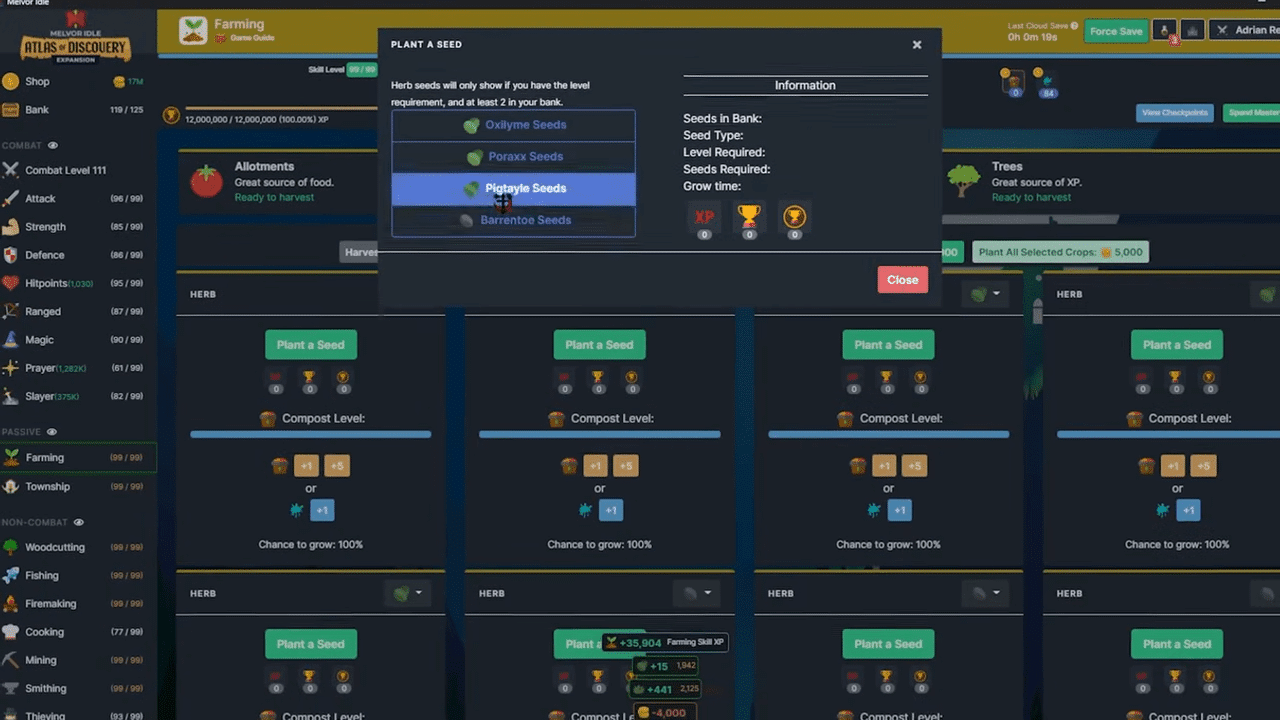
Herblore and Farming
Herblore and Farming support Runecrafting, Combat, Farming, and Thieving. Here is a breakdown of notable herbs and their uses:
- Poraxx: Useful for Runecrafting (Rcing).
- Barentoe: Has multiple uses.
- Sourweed: Focus on this for low-level leveling.
- Oxilyme/Lemontyle: Best for mid-level leveling.
- Pigtayle: Use this for high-level leveling.
- Snowcress (DLC): Reserved for very high-level leveling.

Progression and Resource Management
To succeed in Melvor Idle, you must be organized.
Manage Your Bank
Keep your bank organized to avoid wasting time searching for items. You should upgrade your bank slots whenever you can afford to do so to accommodate the influx of new items.
Track the Completion Log
The Completion Log tracks your achievements, pets, and mastery progress. Use it as a definitive guide for your long-term goals.
Shop Wisely
Spend your gold on essential upgrades, such as better tools or gear. You must avoid wasting gold on unnecessary items early on.
Behind the Scenes: A Coding Study on Achievements
Disclaimer: The following section exists for coding study purposes only. Do not perform these actions if you want to have a complete and legitimate game experience. Hacking achievements defeats the purpose of the game.
Melvor Idle runs on JavaScript, which allows players and developers to debug and test game features. For those interested in how the code handles Steam achievements, we can look at the game’s internal functions.
The Technical Setup
To inspect the source code, one would typically play the website version on a browser supporting development mode. According to the official wiki, players can access in-game cheating systems by entering development mode or subscribing to the “dev.Console” mod.
Analyzing the Code
In the development mode, there is a function specifically named unlockSteamAchievement(). The code structure looks like this:
function unlockSteamAchievement(achievementName, i) {
try {
nativeManager.isUsingGreenworks
? parent.greenworks.activateAchievement(achievementName, function () { })
: parent.steamworksClient.achievement.activate(achievementName);
steamAchievements[i] = 1;
}
catch (e) {
console.error(e);
}
}
This function suggests that running the command parent.steamworksClient.achievement.activate(achievementName) would activate an achievement. However, the variable achievementName is not the English name you see on Steam. It requires a specific internal definition.
Finding the Achievement Names
Further investigation into the source code reveals an initialization function called initSteam(). This function tracks down to a method called checkSteamAchievements(). Inside the Game class, there is a specific reference to this.steamAchievementNames.
Since the object of the class Game is game, running the command game.steamAchievementNames in the console lists the internal series of names required by the activation command.
The Theoretical Method
Based on this code analysis, the method to manipulate achievements involves three steps:
- Subscribe to and activate the official “dev.Console” mod in the Steam version.
- Run the command
game.steamAchievementNamesto retrieve the internal ID list. - Run the command
parent.steamworksClient.achievement.activate("...")inserting the specific names found in step 2.
This demonstrates how the JavaScript structure interfaces with the Steamworks client, offering a fascinating look at how the game handles external data synchronization.

Conclusion
Melvor Idle is a game of patience and optimization. It rewards those who plan ahead and understand the deep connections between skills. Focus on building a strong foundation in resource gathering and gradually transition to combat as you level up.
Remember that progression can be slow at first, but it becomes immensely rewarding as your skills improve. Whether you are maximizing your Township profits, calculating the best Summoning synergies, or simply trying to keep your bank organized, there is always a new goal to chase. Good luck, and enjoy the grind.

(lol) next to the timer.
Leave a Reply