
Last Updated on 12 January, 2026
Most people play CloverPit like a slot machine. They pull the lever, cross their fingers, and pray that the random number generator shows them mercy. That is a mistake. To truly beat the debt, you must stop treating this like gambling and start treating it like a math problem.
We are cracking open the game’s source code to show you exactly how the machine thinks. This is not a collection of vague superstitions or feeling lucky strategies. This is a breakdown of the cold, hard algorithms that dictate every spin, every shop restock, and every phone call. The game operates on rigid schedules and precise formulas. Once you see them, you cannot unsee them.
You are about to learn why your luck seems to arrive in waves, why the debt eventually climbs a vertical wall, and how to predict the exact moment the machine decides to pay out. The house always wins, but only because the house knows the math. Now, you will too.
Table of Contents
- The Secret Weights of Symbols
- How Luck Actually Functions
- Predicting Spontaneous Luck
- The Case for Depression
- The Override Codes: 666 and 999
- Deciphering the Multiplier Math
- The Probability of Rare Loot
- Mastering the Phone Calls
- Unlocking Powerful Modifiers
- The Brutal Economics of the Pit
- Conclusion
The Secret Weights of Symbols
When you look at the slot machine, you are not seeing a wheel with equal chances. You are looking at a weighted list where the game prefers to give you garbage. The internal code assigns a specific weight value to every symbol, and the game uses these numbers to determine what lands on the grid.
The starting landscape favors low-value fruits heavily:
- Lemon: 1.3 (19.4%)
- Cherry: 1.3 (19.4%)
- Clover: 1.0 (14.9%)
- Bell: 1.0 (14.9%)
- Diamond: 0.8 (11.9%)
- Treasure: 0.8 (11.9%)
- Seven: 0.5 (7.5%)
As you can see, the game assigns a weight of 1.3 to both Lemons and Cherries. In contrast, the Seven holds a tiny weight of 0.5, giving it a mere 7.5% chance of appearing.
Manipulating the Weights
You can change these numbers. Every time you pick an upgrade that claims a symbol will manifest more often, the code adds a flat 0.8 to that symbol’s weight. This is a massive swing. If you apply a single (+1) buff to Sevens, their weight jumps from 0.5 to 1.3. Suddenly, Sevens become just as common as Lemons and Cherries.
The Trap of Diminishing Returns
Smart players need to understand that this system suffers from diminishing returns. Because you are increasing the weight relative to the total pool, your first upgrade is always your strongest. That first boost to Sevens increases their appearance rate by roughly 9.8%. If you add a second boost immediately after, the math yields only an 8.0% increase. By the time you apply your tenth upgrade to the same symbol, you are fighting for a meager 2.4% gain.
The Math of Halving
Occasionally, an effect will halve the chance of a symbol. The game takes the current weight value and divides it by two. However, the game calculates additions independently. If you have a halved symbol but you pick a (+1) upgrade, you still get the full +0.8 weight added to the total. This means you can brute-force your way out of a penalty if you invest enough upgrades into a specific symbol.
How Luck Actually Functions
Forget everything you think you know about chance. In CloverPit, the Luck stat acts as a command, not a suggestion. It does not simply make good things more likely to happen. It forces them to happen.
Every single point of Luck you acquire targets one symbol on the slot machine and forces it to become a winning symbol. The game runs this check before it even shows you the results. The thresholds are strict and binary:
- 7 Luck: The game forces at least 7 symbols to match.
- 10 Luck: The game forces at least 10 symbols to match. This guarantees a win unless a specific 666 roll overrides it.
- 15+ Luck: The game forces a Jackpot.
The game still relies on the weighted probabilities we discussed earlier to decide *which* symbol creates the match. If you have high Luck but you have left Lemons as your highest weighted symbol, your forced win will likely be a board full of Lemons. The Luck stat ensures a match, but your weight manipulation determines the value of that match.
Predicting Spontaneous Luck
You have likely noticed moments where the screen sparks and you receive a random burst of Luck. The game calls this Spontaneous Luck. Most players assume this is random RNG to help them out. It is actually a rigid schedule running in the background.
The Initial Luck Spin (ILS) Schedule
During your First Debt, the game puts you on one of five pre-determined tracks. At the start of a run, the code picks an offset number between 0 and 4. This number locks you into a specific sequence of spins that will always trigger sparks.
To use this list, simply note which spin number gives you your first spark, and match it to one of the sequences below. You can then predict every future lucky spin for the rest of the debt.
- 3, 9, 17, 20, 35, 39, 43…
- 2, 8, 16, 19, 34, 38, 42…
- 5, 7, 15, 18, 29, 33, 37…
- 4, 6, 11, 14, 28, 32, 36…
- 3, 10, 13, 23, 27, 31, 65…
When one of these spins triggers, the code grants you a random Luck boost between +4 and +8.
The Occasional Luck Spin (OLS) Formula
Once you clear the first debt, the game switches to a mathematical formula to decide when to help you. The first boost of a new deadline happens randomly within the first 5 spins. After that, the game sets a timer based on this calculation:
Current Spin + 4 + (Completed Deadlines) + (Random 0 or 1)
This means the gaps between lucky spins grow larger as you progress. In the second debt, you get a boost every 5 or 6 spins. By the fourth debt, you wait 7 or 8 spins. The boost amount also depends on the spin count. If your lucky spin lands on a multiple of 7, you get a massive +7 to +9 Luck. Multiples of 3 grant +5 to +7.
The Pity Mechanic
The game has one final mercy rule. If you miss a reward for 4 spins in a row, the game injects +5 Luck into your next spin. This creates sparks just like the scheduled boosts, so you need to be careful not to confuse a Pity Spin with a scheduled Luck Spin when trying to predict your sequence.
The Case for Depression
The Depression Charm disables all Spontaneous Luck. On paper, this sounds terrible. Why would you want to turn off the game’s helping hand? The answer lies in control.
High Luck forces matches, and forced matches often override delicate board states. If you are running a Train build or a strategy that relies on very specific, small patterns, a massive injection of Luck might ruin your board by forcing a screen full of Lemons. Depression ensures that the board state remains pure and unaffected by the game’s interference.
When you equip Depression, the Initial Luck Spin schedule keeps running silently in the background; you just skip the rewards. However, the Occasional Luck Spin timer pauses completely. It resumes exactly where it left off once you remove the Depression Charm. While you are depressed, the game still counts your losses, but it will not trigger the Pity Spin mechanic until you cheer up.
The Override Codes: 666 and 999
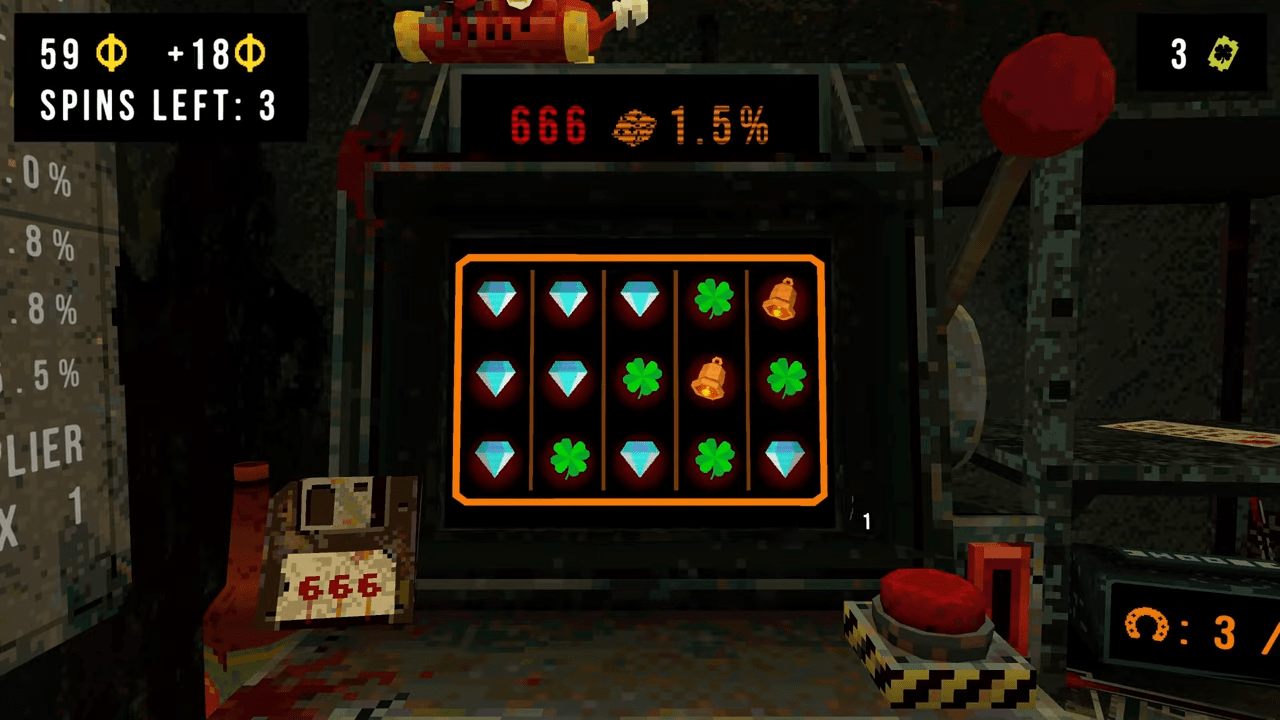
Sometimes the game ignores your stats completely. The 666 and 999 rolls are override events. They happen after all other calculations, meaning no amount of Luck can prevent a 666 from draining your wallet.
The 666 Probability
The code runs a specific gauntlet of checks to see if it should destroy your run. It checks for a Triple Six (capped at 30%), then a Double Six (6%), and finally a Single Six (7.5%). When you do the math, you have roughly a 14.4% chance of seeing some form of six on any given spin. This is a constant threat that never goes away.
The 999 Jackpot
The 999 event uses the exact same logic and probability structure as the 666. The difference is that instead of taking your money, it pays out your current round’s earnings a second time. This works regardless of whether you have the Super 999 unlock. It is effectively a free double-down on your current win.
Deciphering the Multiplier Math
Big numbers in this game come from understanding the four-part scoring equation. The game calculates your payout by multiplying four distinct values: Symbol Value, Symbol Multiplier, Pattern Value, and Pattern Multiplier.
Because these numbers multiply each other, increasing the lowest number usually results in the biggest gain. However, the game does not distribute these stats equally. Symbol Multipliers are common and come in large chunks. Pattern Multipliers are rare and usually come in small increments.
This scarcity makes Pattern Multipliers inherently more valuable. If you see an option to increase your Pattern Multiplier by 1, it is almost always mathematically superior to increasing your Symbol Multiplier by 1, simply because you will have fewer opportunities to raise the Pattern stat later.
The Probability of Rare Loot
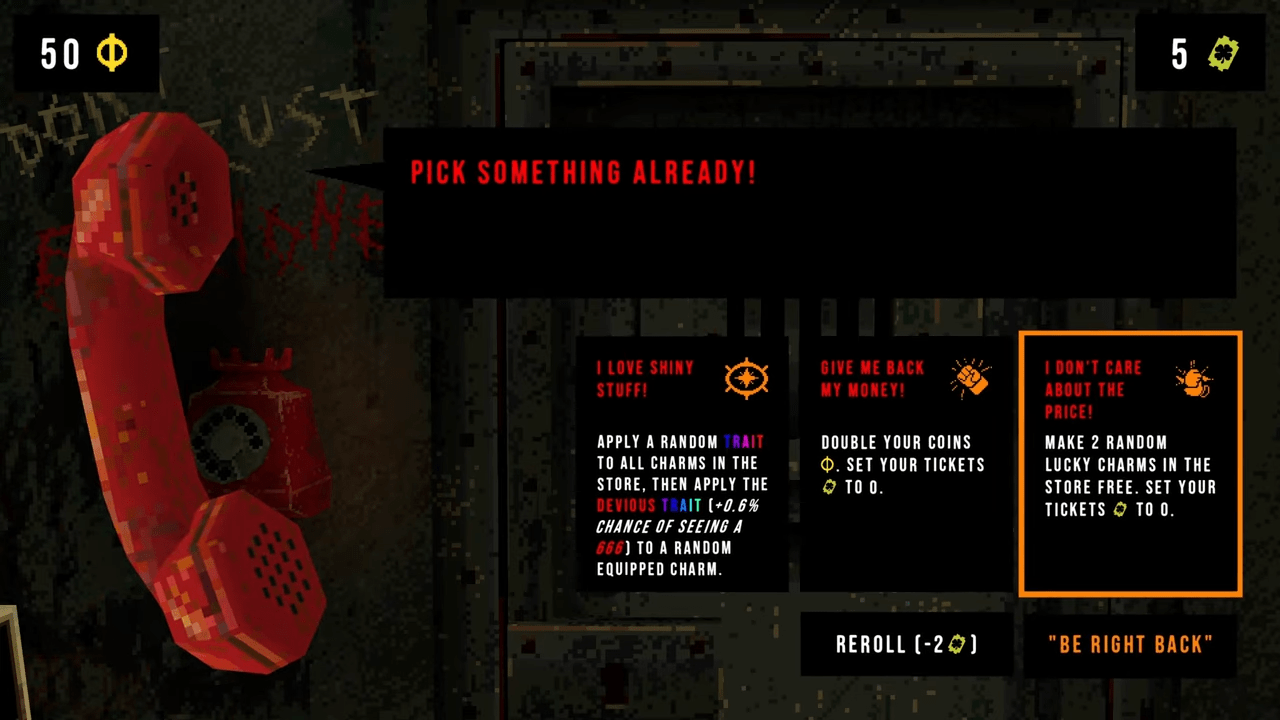
The shop does not show you everything. It filters items based on a hidden rarity tier list. The game classifies Charms into groups ranging from Common to Ultra Legendary. Each tier has a specific probability penalty.
When the shop populates, it picks a random item and rolls a die. If the item is Common, it stays. If the item is Ultra Legendary, it has an 80% chance to fail the check and be rerolled. The game will attempt to reroll an item slot up to 100 times to find a valid item. This ensures that while rare items are difficult to find, the shop will never be empty.
Memory Cards utilize a similar system but with fewer tiers. Epic cards suffer a 50% penalty to their appearance rate compared to Common cards. Phone options also follow this rule, though the game is much more persistent, attempting up to 1,000 rerolls to fill your phone screen with valid choices.
Mastering the Phone Calls
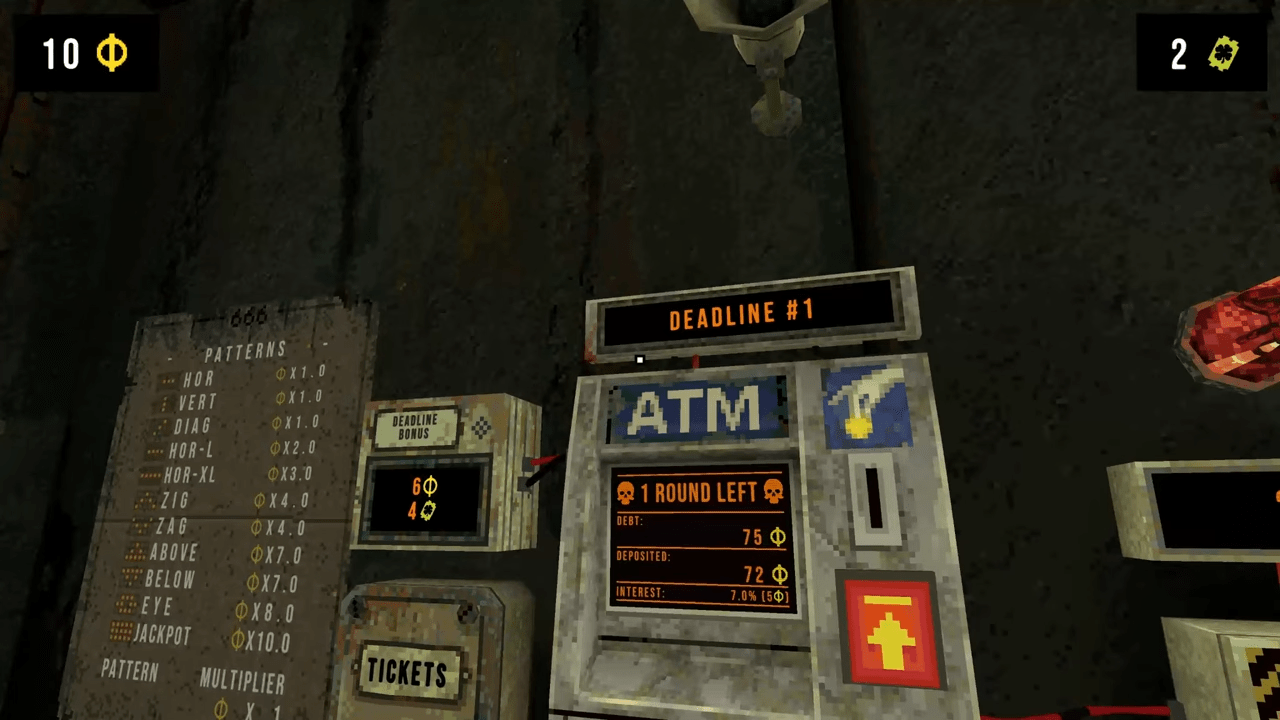
The phone offers high-risk, high-reward choices. While most calls are random, two specific types of calls trigger based on your actions: Evil Calls and Holy Calls.
Triggering Evil and Holy Calls
An Evil Call (red text) triggers if you unlocked 666 at the start of the deadline, unlocked Super 666, or rolled a 666 in the previous round. The Holy Call works the same way but requires a 999 event. You must pick up the phone to bank this status. If you roll a 666 and ignore the phone for the rest of the deadline, the game forgets the event happened.
Phone Call Abilities
Most players guess at what these calls do. Here is the data so you know exactly what you are buying.
Normal Call Options
| Ability Name | Description |
|---|---|
| Please don’t throw my stuff away! | Increase Charm’s space by 1, permanently. |
| I can’t quit now! | Double Jackpot’s value. |
| Can I borrow some green? | +5 Coins. |
| Can I eat something? | Lucky Charms at the store are discounted by 2 Coins until the next Restock. |
| This time I’m betting on Green/Yellow/Orange / If I keep trying, the patterns will align! / It’s kinda fun! / I’m sure the value will rise! | Add the Florid/Avid/Ambitious/Obsessive/Gambler/Speculative Trait to a random Lucky Charm you have equipped. |
| Can you give me some Energy Drinks? | Restore all Charges on all Charms triggered by the Red Button. |
| Life gave me lemons / I used to eat healthy… / Today’s my Lucky day! / I need to be there! / Please! I’ll give you anything! / I need money! / I didn’t hurt anybody… | Lemons/Cherries/Clovers/Bells/Diamonds/Treasures/Sevens manifest more often (+1), permanently. |
| I need supplements! / I’m feeling lucky / Gold and Diamonds are a good investment! / I’m gonna go All In! | Double the value of Lemons and Cherries / Clovers and Bells / Diamonds and Treasures. Triple the value of the Seven. |
| I’m thinking of some strategies! / I found a winning strategy! | Increase the value of Patterns with 3 or less / 4+ symbols by their base value. |
Evil Call Options
| Ability Name | Description |
|---|---|
| I love shiny stuff! | Apply a random Trait to all Charms in the Store, then apply the Devious Trait to a random equipped Charm. |
| I like Cryptic values! | Double your Clover Tickets. Set your coins to 0. |
| I don’t care about the price! | Make 2 random Lucky Charms in the store free. Set your Tickets to 0. |
| My head hurts! | Activate all other current phone abilities. Then apply the Devious Trait to a random equipped Charm. |
| Give me back my money! | Double your coins. Set your Tickets to 0. |
| There’s nothing to eat but mould. / Wait, what day is it? / I’ve already bet it all! | Halves the base chances to manifest Lemons and Cherries. / Halves Clovers and Bells. / Halves Diamonds, Treasures, and Sevens. |
Holy Call Options
| Ability Name | Description |
|---|---|
| I’m re-organizing my mind! | Symbols Multiplier +3. |
| I see the patterns in my behaviour. | Patterns Multiplier +1. |
| I’m feeling more energetic recently. | All equipped Lucky Charms triggered by the Red Button take 1 less Charge to restore. |
| I need to heal myself. | Modify all Lucky Charms in the store, then make one free. |
| I’m being constant! | Patterns trigger 1 more time, permanently. |
| Help! | Spawn a Sacred Lucky Charm on the Table. Then halve your coins. |
| I want to address some stuff. / I’ll take back control of my life. | Double the value of all patterns with 3 or less / 4+ symbols. |
The Cost of Rerolling
You can reroll phone options, but the price is deceptive. The base cost is your Current Deadline minus 1. Every time you hit the reroll button, the cost increases by 1. This sounds cheap, but on later deadlines, the starting cost alone can be significant.
Unlocking Powerful Modifiers
Modifiers are passive buffs like Polished or Ancient that attach to your Charms. You might play for hours and never see one, or you might see them constantly. This is because Modifiers are locked behind three specific gates.
The game code forbids Modifiers from appearing unless you meet at least one of these conditions:
- You have completed 3 or more runs.
- You have unlocked at least one drawer.
- You are currently on the second debt (or later).
Once you meet a condition, the game rolls against a probability table. For example, the Florid modifier (+2 Coins) has a 2% chance to appear normally, but a 19% Forced probability in specific scenarios. Note that consumable Instant Charms are almost completely barred from receiving modifiers.
The Brutal Economics of the Pit
CloverPit is an economic survival horror game. The debt curve is the monster. For the first nine deadlines, the game uses fixed values to ease you in. Deadline 1 asks for a paltry 75 coins. Deadline 5 asks for 12,500.
At Deadline 10, the math changes. The game switches to an exponential formula involving an OverLimit variable. The numbers go vertical instantly. Deadline 10 requires 6 million coins. Deadline 15 demands over 10 sextillion (10^22). By Deadline 20, the number is so large (10^89) it exceeds the number of atoms in the visible universe.
Debt Penalties: Skeletons and Grandeur
The number listed above is just the Base Debt. The game multiplies this number based on your loadout:
- Skeleton Charms: Each Skeleton Charm adds a 5% penalty to your debt. This is additive (2 charms = +10%).
- Delusions of Grandeur: If you have this Memory Card, the total debt is doubled.
The formula applies the Skeleton penalty first, then doubles the result if Grandeur is present.
The Hidden Cost of Spinning
You have to pay to play. The cost to spin the machine rises alongside the debt. The formula starts at 1 and increases by 2 after every deadline (except the first). On top of that, a multiplier kicks in every five deadlines. This ensures that your basic operating costs eventually become a significant drain on your resources.
Formula: max(1, 2 * (Current Deadline – 1) * (1 + ((Current Deadline – 1) / 5)))
Restocking Strategy
Restocking the shop is essential, but dangerous. The cost to restock is based on your *current* debt. Worse, every time you restock, the price increases based on the current cost. This creates a mini-exponential curve within the shop itself. However, this penalty resets at the start of a new deadline.
Conclusion
CloverPit rewards the informed. By stripping away the flashing lights and looking directly at the code, you can see the rigid skeleton that holds the game together. The symbols follow weights, the luck follows a schedule, and the debt follows a curve.
The game does not cheat. The bad luck you feel is just variance within the 14.4% chance of hitting a six. Now that you understand the machinery, you can stop playing like a gambler and start playing like the house. Watch the spin count, track your sequences, and optimize your multipliers. The pit is deep, but the math is solvable. Good luck.


Leave a Reply